
SkyPixel Photography Awards Analysis: Subjects, Viewpoints and Landscapes
SkyPixel is DJI’s global aerial photography and videography community, and its annual photography competition has been running since 2015. Over that time it has become one of the best-known competitions associated with drone photography, recognising work across a very broad range of subjects. I have followed the awards for years and had developed two fairly strong impressions from the photographs selected by the judges: that top-down photography seemed to dominate the results, and that natural landscapes appeared relatively rarely among the awarded images, particularly the sort of oblique aerial landscapes I tend to make myself.
For this article I wanted to test those impressions properly, but also look more broadly at what actually gets recognised in SkyPixel. I wanted to see which subjects feature most strongly, how the use of top-down photography changes between different types of subject, and whether there were any obvious patterns in the results. From there I could return to my own assumptions about natural landscapes, before comparing them with the results of the International Aerial Photographer of the Year Awards.
To do that, I reviewed 130 photographs awarded by the judges across the first 11 SkyPixel contests, including the results announced in 2026. I recorded the main subject of each image and whether it was photographed looking essentially straight down or from an oblique angle. I also separated natural landscapes from landscapes that were substantially shaped by human activity.
What the SkyPixel results show
The largest subject group in the SkyPixel results was People & Activity, with 56 of the 130 photographs I analysed, or 43.1% of the total. Landscape photography came next with 47 images, accounting for 36.2%, followed by Wildlife at 11.5% and Urban & Architecture at 9.2%.
Within the landscape category, 33 photographs were what I classified as natural landscapes. That means natural landscapes accounted for 25.4% of all the judge-awarded photographs in the dataset.
Figure 1.
SkyPixel Awards by Subject
Based on an analysis of 130 images awarded by SkyPixel judges across 11 contests, including the latest results announced on 27 April 2026.
analysed
The subject breakdown becomes considerably more interesting when viewpoint is added. Across the entire dataset, 75.4% of the photographs were top-down, but that figure changes substantially depending on what was being photographed.
Every Wildlife photograph I recorded was top-down. Among People & Activity images, the figure was almost as high at 89.3%. Landscapes were much more balanced, with 61.7% top-down, while Urban & Architecture went in the opposite direction, with only 33.3% photographed from directly above.
Table 1.
SkyPixel Viewpoint by Subject
Based on an analysis of 130 images awarded by SkyPixel judges across 11 contests, including the latest results announced on 27 April 2026.
| Subject | Images | Top-down | Oblique or horizontal |
|---|---|---|---|
| Wildlife | 15 | 15 (100%) | 0 (0%) |
| People & Activity | 56 | 50 (89.3%) | 6 (10.7%) |
| Landscape | 47 | 29 (61.7%) | 18 (38.3%) |
| ↳ Natural landscape subset | 33 of 47 | 19 (57.6%) | 14 (42.4%) |
| Urban & Architecture | 12 | 4 (33.3%) | 8 (66.7%) |
This is probably the most interesting part of the wider SkyPixel analysis. The competition undoubtedly has a strong top-down character, but that preference is not spread evenly across every type of photography. Exactly 50% of all the photographs I analysed were either top-down People & Activity images or top-down Wildlife photographs. At the other end of the scale, 26 of the 32 photographs that were not top-down were either landscapes or Urban & Architecture images.
The overall appearance of the SkyPixel results is therefore influenced heavily by the subjects that feature most strongly. People, activity and wildlife are overwhelmingly represented from directly above, while landscape and architecture leave considerably more room for other viewpoints.
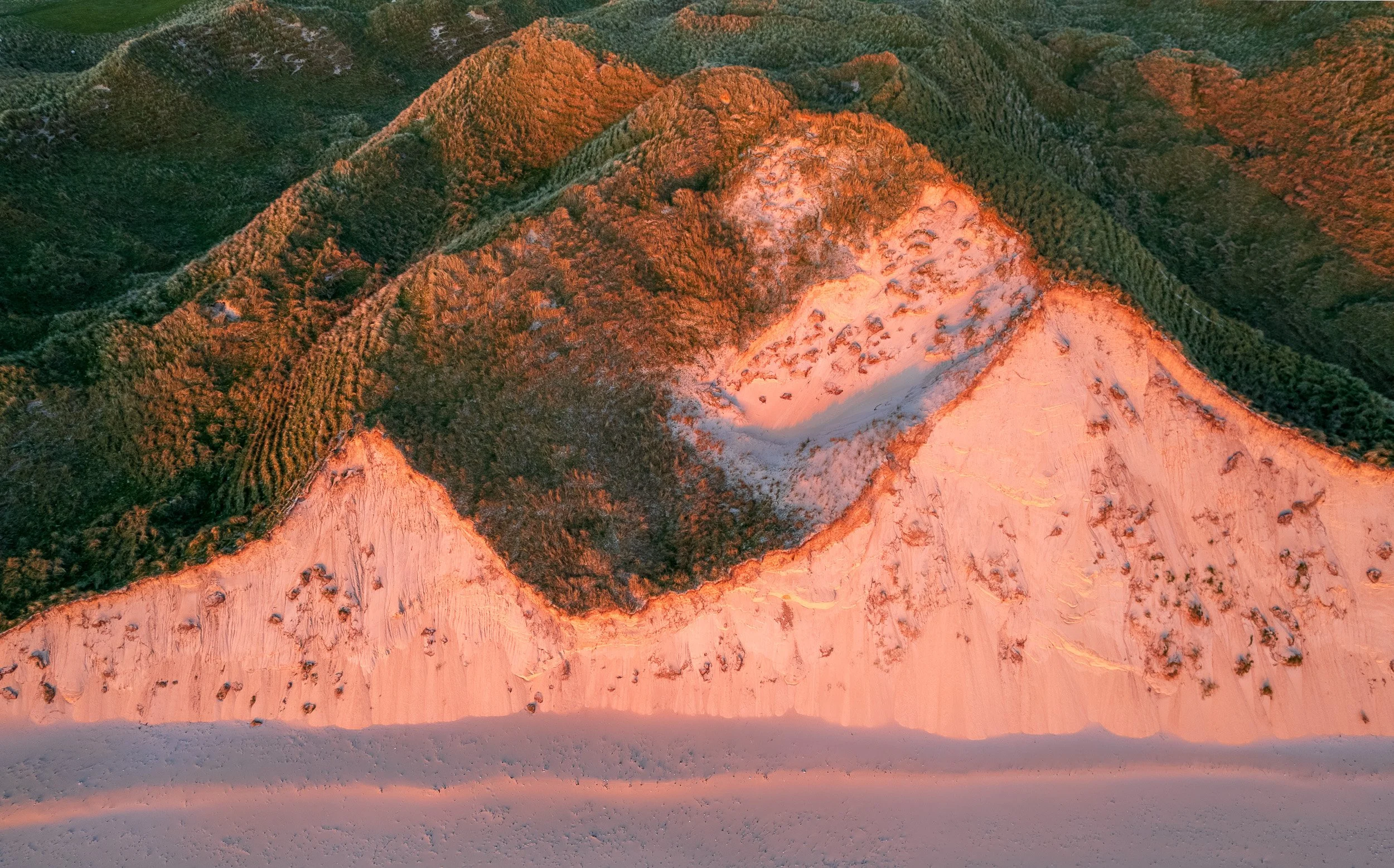
Oblique aerial photograph of the sand dunes at Five Fingers Strand in County Donegal, Ireland, taken with a DJI Mavic 3 Pro.
Were my impressions of SkyPixel right?
My first impression was straightforward: top-down photographs seemed to dominate the results. The figures clearly support that. 75.4% of the photographs I analysed were taken looking essentially straight down, so this was not simply a case of remembering the most graphic or immediately striking images.
My second impression was more specific to the photography I make myself. Most of my drone work consists of natural landscapes photographed from an oblique angle, and that sort of image had always seemed relatively scarce among the SkyPixel results. Again, there was some truth in that impression. Only 33 of the 130 photographs I analysed were natural landscapes, accounting for 25.4% of the total. Natural landscape photography genuinely occupies a relatively small part of the work recognised by the SkyPixel judges.
Where the analysis changed my view was in the way those natural landscapes were photographed. Of the 33 images, 19 were top-down and 14 were oblique, giving a split of 57.6% to 42.4%. I had expected the difference to be much greater. The SkyPixel results as a whole are heavily weighted towards top-down photography, but within natural landscapes the balance is much closer. There are relatively few oblique natural landscapes in the awards, but that appears to be largely because there are relatively few natural landscapes in the first place, rather than because SkyPixel strongly favours top-down viewpoints within landscape photography.
Comparing SkyPixel with International Aerial Photographer of the Year
I wanted some context for that result, so I carried out the same basic analysis on the 2025 and 2026 selections from the International Aerial Photographer of the Year Awards.
The difference in the amount of natural landscape photography was substantial.
Table 2.
Natural Landscape Representation
Share of judge-recognised images classified as natural landscapes.
| Competition | Natural landscapes |
|---|---|
| SkyPixel | 25.4% |
| International Aerial Photographer of the Year Awards | 48.5% |
Natural landscapes accounted for 48.5% of the International Aerial Photographer of the Year photographs I analysed, compared with 25.4% at SkyPixel. For someone whose aerial photography is centred mainly on natural landscapes, that is a significant difference between the two competitions.
What surprised me was how little difference there was when I looked at viewpoint. Among natural landscapes, 57.6% of the SkyPixel photographs were top-down, compared with 55.1% in the International Aerial Photographer of the Year results. Oblique photographs accounted for 42.4% and 44.9% respectively.
For all the difference between the competitions in how often natural landscapes appear, the balance between top-down and oblique landscapes is therefore almost identical.
Having gone through every photograph individually, I also thought the overall standard of the International Aerial Photographer of the Year selections was more consistently high. That is entirely subjective, and both competitions contain excellent photography judged by highly accomplished photographers, but it was a noticeable impression after spending this much time looking closely at the work.
A broader view of drone photography
One of the more useful things to come out of the analysis has been a reminder of how broad aerial photography actually is.
SkyPixel brings together wildlife, architecture, people, abstract top-down work and natural landscapes in the same competition. Those subjects can require completely different photographic skills. Nobody would assume that a photographer using a conventional camera should be equally accomplished at portraiture, wildlife, architecture and landscape photography simply because all of those photographs are made with a camera. Using a drone does not make those distinctions disappear.
I mainly use mine as a landscape camera. Most of my aerial work involves gaining height and photographing across a scene, looking for many of the same things I would with a camera on the ground: light, depth, atmosphere and composition.
Going through the SkyPixel results has reminded me that this is only one way of using a drone. There is a great deal of successful work built around pattern, human activity, wildlife and subjects that only really reveal themselves when viewed from directly above. I have no particular interest in using my drone to photograph people and human activity, but there are other areas of aerial photography that I would like to explore more than I have in the past.
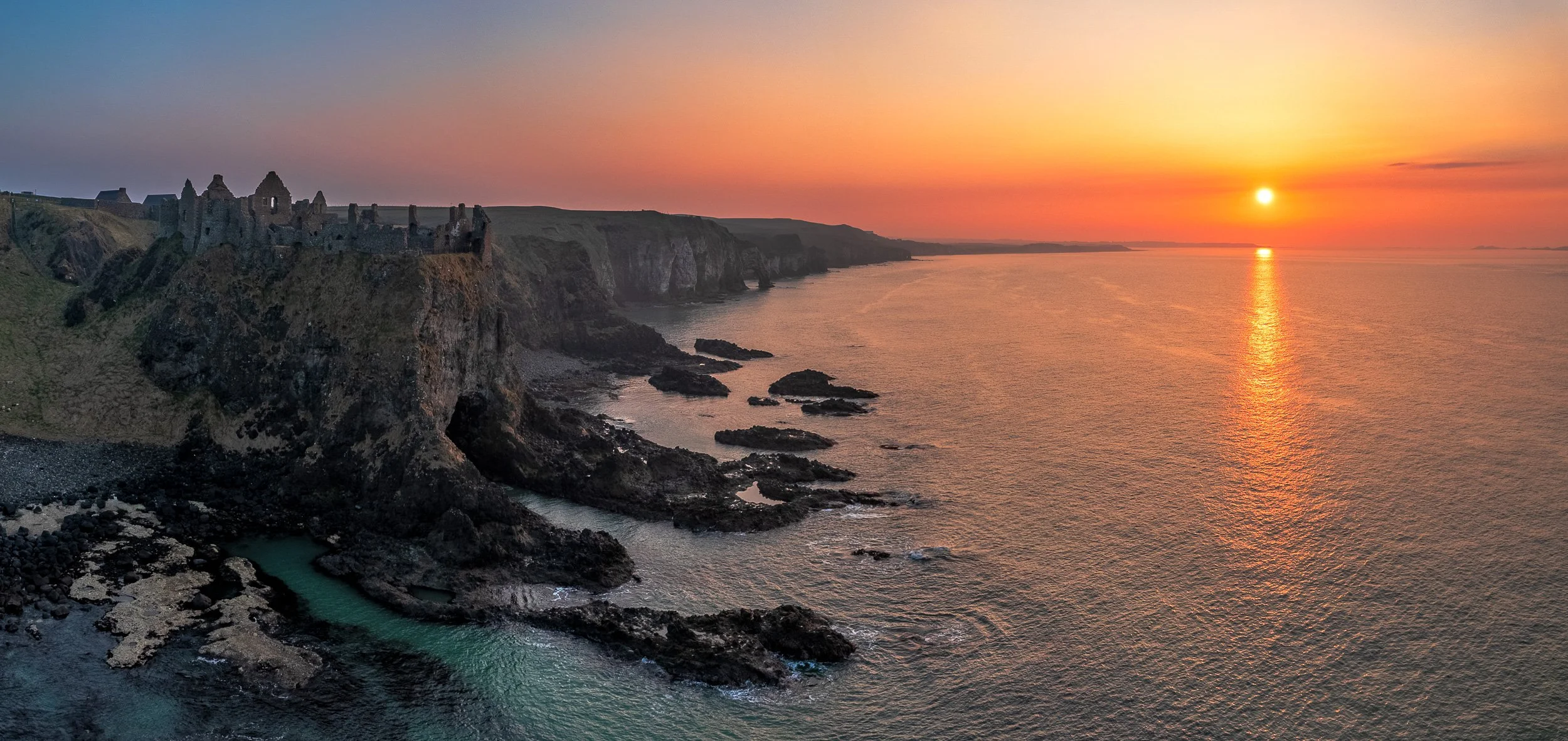
Dunluce Castle at sunset on the County Antrim coast, Northern Ireland. Photographed with a DJI Mavic 3 Pro as a bracketed aerial panorama.
Final thoughts
Looking at the SkyPixel results as a whole, the clearest pattern is not simply that top-down photography dominates, but that what gets rewarded varies considerably by subject. People & Activity was the largest category in the photographs I analysed, accounting for 43.1% of the total, and both that category and Wildlife were overwhelmingly top-down. Landscapes were much more evenly divided, while Urban & Architecture was more often photographed from an angled viewpoint. The overall SkyPixel look is therefore shaped as much by the subjects that feature strongly as by any single preferred way of using a drone.
Against that broader picture, my original impressions were still largely correct. Top-down photographs do dominate the awards, and natural landscapes make up a relatively small proportion of the work recognised by the judges. What I had not appreciated was that, once natural landscapes are considered on their own, oblique views are not especially unusual. They accounted for 42.4% of SkyPixel’s natural landscapes, which is far closer to an even split than I had expected.
I have no personal interest in using a drone to photograph people or human activity, so the fact that 43.1% of the SkyPixel photographs I analysed fell into that category is unlikely to change what I photograph. I will still enter SkyPixel, but I will do so with a better understanding of what features most strongly in its results and adjust my expectations accordingly. That is quite different from changing my photography simply to suit a competition.
The comparison with the International Aerial Photographer of the Year Awards has also made me pay much more attention to that competition. I thought the overall standard of the awarded photography was more consistently high, but just as importantly for me, natural landscapes occupied a much larger part of the results — 48.5% compared with 25.4% at SkyPixel. The near-identical balance between top-down and oblique natural landscapes in the two competitions also suggests that viewpoint itself is not the main difference; it is the amount of space each competition gives to natural landscape photography.
For me, that has made the exercise more useful than simply confirming or disproving a couple of assumptions. SkyPixel shows just how broad aerial photography has become, and how different the skills involved can be from one subject to another. I still mainly use a drone for oblique natural landscapes, but looking at the results this closely has made me want to experiment more with some of the other possibilities I have probably overlooked, while also giving me a much clearer idea of what to expect when I enter the two competitions.
Summary of findings
Analysis summary
Key Findings at a Glance
Based on an analysis of 130 images awarded by SkyPixel judges across 11 contests, including the latest results announced on 27 April 2026.
The figures below consider only the natural landscape images in each competition. Despite the large difference in how often natural landscapes appeared, their viewpoint split was remarkably similar.